On December 1, 2025, to celebrate the 40th anniversary of the establishment of the College of Physics and Optoelectronic Engineering at Shenzhen University, the college successfully held an academic symposium on “Stress Luminescence”. This event invited distinguished speakers, including Academician Xu Chaonan from the College of Engineering at Tohoku University, Professor Zheng Xuguang from the Faculty of Science and Engineering at Saga University (also a professor at the School of Engineering, Tohoku University), Professor Dong Lin from the College of Physics at Zhengzhou University, and Professor Marcin Runowski from Adam Mickiewicz University in Poland, who delivered specialized reports. Liu Liwei, Executive Vice Dean of the College of Physics and Optoelectronic Engineering, and Zhu Deliang, Dean of the College of Materials, attended the event. Graduate students and postdoctoral researchers from the College of Physics and Optoelectronic Engineering, College of Materials, and College of Civil and Transportation Engineering at Shenzhen University participated in the exchange and discussion. Other attending scholars included Professor Gan Jiulin from South China University of Technology, Professor Yang Fan from the School of Science at Sun Yat-sen University (Shenzhen), Researcher Sun Junlu from the College of Physics at Zhengzhou University, Professor Li Leipeng from the College of Physics at Hebei University, Professor Zheng Teng from Zhejiang University City College, and Professor Fei Jianbo, Professor Peng Dengfeng, Professor Fu Yu, Assistant Professor Liu Xianglei, and Assistant Professor Liu Shengqiang from Shenzhen University, as well as Researcher Wang Chunfeng from the College of Materials at Shenzhen University. The symposium was hosted by Professor Peng Dengfeng and was held in Room 2001, Huiyan Building, Shenzhen University.
At the beginning of the event, Academician Xu Chaonan shared her research experience vividly with the audience, particularly young faculty members and graduate students. She compared scientific research to the changing of the “four seasons”, emphasizing the need to explore in harmony with the natural flow, adapt flexibly, and encouraged young scholars to persevere in their research and venture into new fields with innovation.
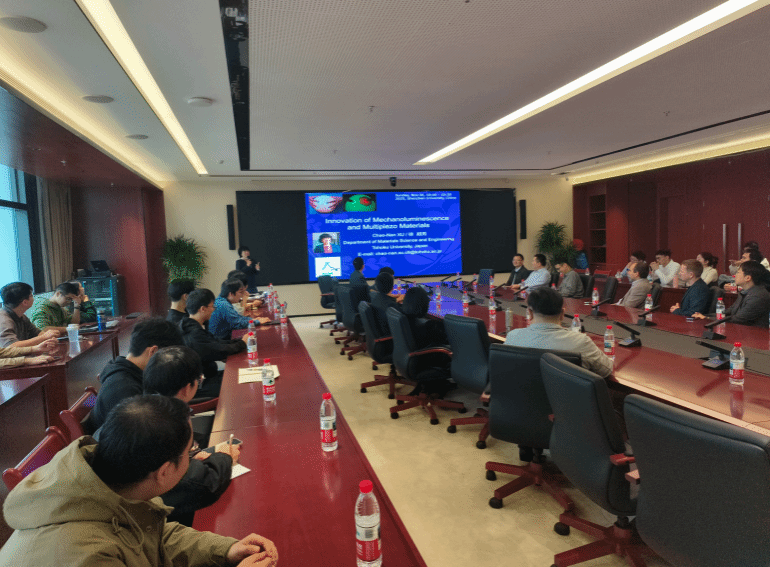
Next, Professor Zheng Xuguang explained the understanding of stress luminescent materials from the perspective of magnetism. He introduced a new phenomenon found in traditional SrAl2O4:Eu materials, where only 0.1% of rare-earth ions can induce a ferromagnetic phase transition. This phenomenon is believed to be realized through the polarons, enabling long-range magnetic interactions between rare-earth ions. This innovative discovery contributes to the exploration of the mechanism of stress luminescent materials and their applications.

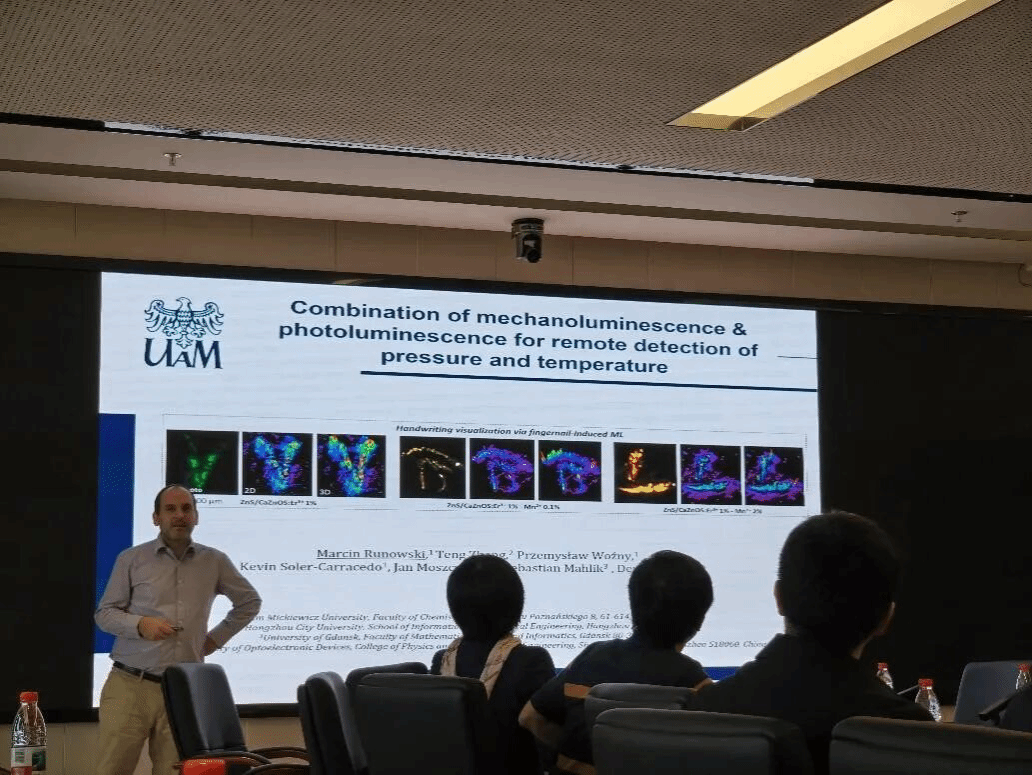
Then, Professor Marcin Runowski highlighted the research progress of his team in ultrasound-induced stress luminescence. They achieved efficient acousto-optic conversion using Er3+ and Mn2+ co-doped ZnS/CaZnOS heterojunction materials. Based on the excellent temperature characteristics of ultrasound-induced stress luminescence, the materials showed potential applications in remote monitoring and temperature detection. He also reported the long afterglow and stress luminescence properties of Sr2MgSi2O7:Eu2+/Dy3+ under high-pressure conditions.
Finally, Professor Dong Lin presented a series of innovative studies on tactile sensing and information storage. Inspired by the structural characteristics of human skin hair follicles, he developed a skin-like mechanical luminescent micro-fiber array film using a template method. This structure, with its high aspect ratio, caused stress concentration, resulting in an ultra-low stress luminescence activation threshold of about 10 mN. Additionally, based on the concept of artificial all-optical synapses, he realized luminescent materials with three modulation windows—ultraviolet light, thermoluminescence, and stress luminescence—demonstrating excellent optical synaptic plasticity.

After the presentations, there was an in-depth exchange and interaction between the attending experts and the faculty and students. This academic symposium greatly expanded the academic horizons of the faculty and students in the field of stress luminescence and provided new ideas for related researchers. Finally, all participants took a group photo in the Key Laboratory of Optoelectronic Devices and Systems, Ministry of Education, Guangdong Province.


 Add : No. 3688, Nanhai Avenue, Nanshan District, Shenzhen, Guangdong Province
  Email : cpoe@szu.edu.cn
  Phone: 0755-26538735
  Fax : 0755-26538735
