Recently, Chen Songyu, a graduate student from the Advanced Electronics and Intelligent Antenna Team, has made significant progress in the study of ferroelectric phase transitions and external field regulation in two-dimensional wurtzite materials. The findings were published in the prestigious Nature journal, npj Computational Materials, under the title “Giant spin splitting and in-plane multiferroicity in wurtzite monolayer hidden phases,” with Shenzhen University as the first affiliation.
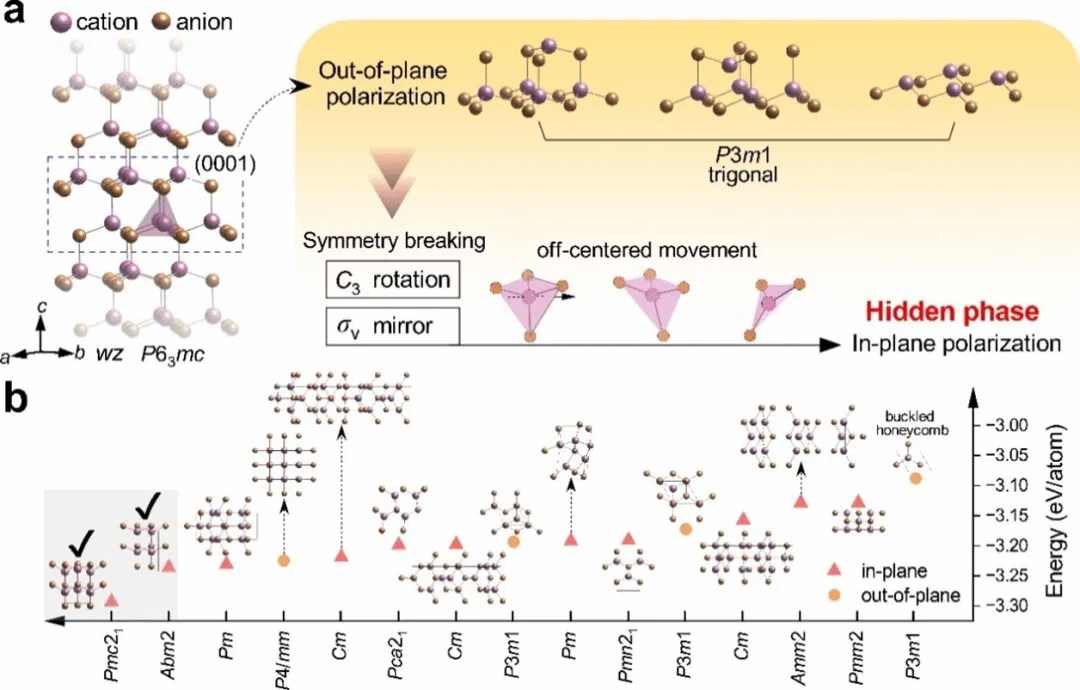
Symmetry Breaking Mechanism and Hidden Ferroelectric Phases of Wurtzite (0001) Plane
Wurtzite (wz) compounds, represented by III-V group semiconductors, play a vital role in electronics, piezoelectronics, and photonics due to their unique tetrahedral coordination structure and excellent intrinsic properties. The wz crystal structure inherently lacks center symmetry, leading to significant piezoelectric effects and spontaneous polarization. Additionally, these materials possess high carrier mobility and excellent thermal stability, making them compatible with traditional semiconductor processes. This characteristic positions them as core materials for high-frequency and RF devices, power electronics, non-volatile storage, and integrated compute-storage architecture chips. However, the ferroelectric applications of wz materials are limited by high polarization switching barriers and coercive electric fields close to the dielectric breakdown limit. To reduce the ferroelectric switching barrier, current research mainly follows two pathways: one is to modify existing wz materials (such as AlN, ZnO) through alloying, doping, or strain engineering, and the other is to explore new wz-type chemical systems with intrinsically low switching barriers. However, these methods often alter the inherent properties of the materials.
Traditionally, the ferroelectric switching in wz relies on the tetrahedral cations overcoming a center-symmetric hexagonal ring intermediate state along the c-axis, where the presence of dangling bonds significantly increases the energy cost. Recent studies suggest that rippled two-dimensional hexagonal phases may form in ultra-thin structures of wz (0001) planes, inducing in-plane ferroelectric switching. However, our team's research reveals that due to structural symmetry constraints, the hexagonal phase only permits out-of-plane polarization on the (0001) surface. To achieve genuine in-plane ferroelectricity, further breaking of rotational symmetry and mirror symmetry is necessary to create effective separation of positive and negative charge centers along the lateral direction. This implies that the experimental conclusions regarding in-plane ferroelectricity on wz (0001) reported in Nature are not complete, and in-plane ferroelectricity is likely “hidden” in unknown two-dimensional polar structures, rather than within the material’s intrinsic phases.
In addressing the key challenges faced by wz materials applications and this fundamental physical issue, our team proposed a symmetry-breaking criterion suitable for realizing in-plane ferroelectric polarization on wz (0001) planes. Utilizing optimized first-principles molecular dynamics methods, we systematically searched for possible atomic configurations on the crystal surface and identified a series of two-dimensional polar ferroelectric phases. Following this strategy, we identified 15 two-dimensional wz structures, including 11 ferroelectric phases and 4 centrosymmetric phases. Among these, two previously unknown ferroelectric phases not only occupy the lowest energy states but can also be exfoliated from the (0001) crystalline surface through atomic slip, with exfoliation energies as low as 0.012 eV/Å⟡, comparable to typical van der Waals materials. These two-dimensional wz materials exhibit various ferroelectric orders and demonstrate excellent electronic and spin properties, including giant spin splitting, ultra-high carrier mobility, reversible transitions between half-metallic and semiconducting states, a wide band gap range from 0 to 4.57 eV, and 24 non-volatile ferroelectric states (4.58 bit/unit). More importantly, the in-plane ferroelectric phase transition of the two-dimensional wz materials can be precisely tuned through transition states, reducing the ferroelectric switching barrier to 3 meV/atom and the coercive electric field to 0.6–1.0 MV/cm, achieving 100% spin polarization control over the band edge through electrical means. This research not only uncovers the fundamental physical mechanisms of in-plane ferroelectricity in wz systems but also showcases the tremendous application potential of two-dimensional wz materials in ferroelectric/multiferroic electronics and spintronics devices. The related research results were recently published in npj Computational Materials (2025, DOI: 10.1038/s41524-025-01884-z), with Chen Songyu as the second author (the first author being the advisor) and Associate Professor Huang Pu as the corresponding author.
Article Link:
https://www.nature.com/articles/s41524-025-01884-z
This work was supported by the National/Guangdong Province/Shenzhen City Natural Science Foundation, the Shenzhen Peacock Team, and the Shenzhen University 2035 Project.


 Add : No. 3688, Nanhai Avenue, Nanshan District, Shenzhen, Guangdong Province
  Email : cpoe@szu.edu.cn
  Phone: 0755-26538735
  Fax : 0755-26538735
